
2026-10-30
Learn how smart home devices differ from integrated home automation systems, compare features and benefits, and discover solutions for villas, apartments, and modern properties in Dubai and the UAE.
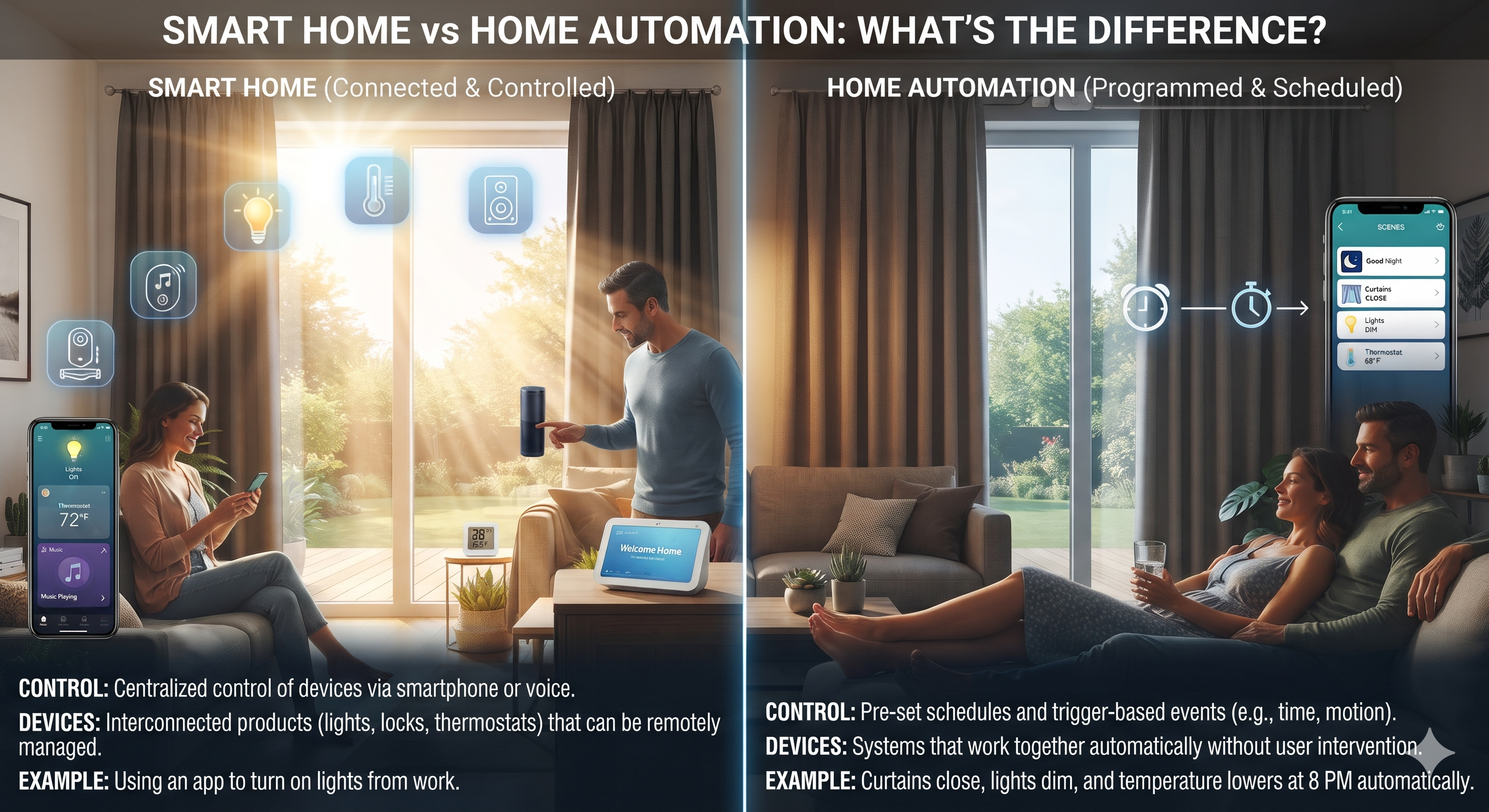
Smart homes and home automation are often used interchangeably, but they do not always mean the same thing. A smart home may contain connected devices that you control through your phone, while a home automation system can coordinate multiple compatible devices to perform actions automatically.
For homeowners in Dubai and across the UAE, understanding this difference can help when planning smart lighting, motorized curtains, climate controls, CCTV, access control, entertainment systems, and other connected features.
At Marvis Technology LLC, we help customers explore smart home and building automation solutions based on their property, lifestyle, and integration requirements. In this guide, we explain how smart homes and home automation compare and how to decide which approach suits your needs.
A smart home is a residential environment that uses connected or intelligent devices to make everyday tasks more convenient. These devices may be controlled through a smartphone application, remote control, voice assistant, wall panel, or another supported interface.
Examples of smart home devices include:
For example, a homeowner might use a smartphone to turn off the living room lights, check a compatible camera, or close the curtains without operating each device manually.
A home can be considered smart even if its devices operate independently and are not connected to one central automation system.
Home automation involves using configured rules, schedules, triggers, or coordinated controls to operate compatible devices with less manual effort. Instead of controlling each device separately, you can create routines that bring several functions together.
For example, a “Good Night” scene might turn off selected lights, close motorized curtains, and adjust compatible climate controls with a single command. Depending on the system, these actions can also be triggered by a schedule, sensor, or another configured event.
Home automation can include:
Automation does not necessarily require every device to be connected to one central controller. Some systems use local controllers, wireless hubs, cloud services, or a combination of technologies. The key distinction is the configured coordination of devices and actions.
| Feature | Smart Home | Home Automation |
|---|---|---|
| Basic concept | Uses connected or intelligent devices | Coordinates devices through rules, schedules, or triggers |
| Device control | Often controlled individually through apps or remotes | Can coordinate multiple compatible devices |
| Automatic actions | May have basic built-in schedules or routines | Automation rules are a central part of the design |
| Scenes and routines | Available on some devices and platforms | Can combine supported functions into coordinated scenes |
| Integration | Devices may operate independently | Compatible systems are configured to work together |
| Installation | May be as simple as installing a connected device | May require planning, configuration, wiring, or controllers |
| Best suited for | People starting with individual smart devices | People seeking coordinated control across several functions |
Important: These categories overlap. Many smart home products include automation features, and a home automation system typically uses smart or electronically controlled devices. The difference is mainly in how the devices are coordinated and managed.
Smart home: You open an application to switch a connected light on or off, or change its brightness.
Home automation: Compatible lights follow a programmed schedule or scene. For example, selected lights may switch on at a configured time, dim for movie night, or respond to a supported sensor.
Explore smart lighting automation in the UAE to learn how lighting controls can be planned around everyday routines.
Smart home: You use a remote or smartphone to open and close motorized curtains.
Home automation: The curtains follow a schedule or form part of a configured scene, such as closing alongside selected lighting changes when you start a movie.
Explore smart home automation solutions for connected control options.
Smart home: You check a compatible camera through its app or receive notifications from a connected sensor.
Home automation: Compatible security events may trigger additional configured actions, such as switching on selected lights. Security functions must be designed carefully so that automation does not interfere with essential protection, privacy, or safe operation.
For dedicated surveillance requirements, explore CCTV installation in Dubai and access control solutions.
Smart home: You use a supported voice assistant to control an individual compatible device.
Home automation: A supported voice command activates a scene that coordinates several compatible functions, such as lighting and curtains.
Learn more about voice control for smart homes. Available commands and integrations depend on the selected platform and devices.
Automated routines can reduce repetitive tasks, particularly in villas and larger homes with multiple lighting zones, curtains, and entertainment areas.
Scenes can be designed for activities such as reading, relaxing, entertaining guests, or watching a film. Compatible devices can adjust together instead of requiring individual changes.
Scheduled motorized curtains and blinds can help manage sunlight and glare. Their effect on indoor heat depends on window orientation, glazing, fabric, and how the coverings are used.
With suitable integration, multiple home functions can be managed through supported controls. This can make the overall experience more consistent than operating unrelated devices separately.
A well-planned installation can make future additions easier, but expandability depends on the chosen platform, wiring, controller capacity, communication protocols, and device compatibility.
The right choice depends on your requirements, budget, property layout, and how much integration you want.
For many homeowners, a gradual approach works well: begin with a clear priority, choose compatible equipment, and expand when additional features provide real value.
Marvis Technology LLC provides smart home and building automation solutions for residential and commercial environments in Dubai and across the UAE. We help customers explore connected control options for lighting, motorized curtains, voice control, security, and other compatible systems.
Whether you are adding a few smart devices or planning a more integrated installation, the starting point is to understand your goals and select suitable equipment for your property.
Explore our services:
Not exactly. A smart home uses connected or intelligent devices, while home automation focuses on coordinating compatible devices through schedules, triggers, rules, and scenes. The two concepts often overlap.
Yes. You can use smart bulbs, cameras, speakers, and other connected devices individually without creating integrated routines across your home.
Yes. Many apartments can support selected smart devices or integrated automation. The appropriate solution depends on the property's wiring, permissions, network, equipment, and installation requirements.
It depends on the system. Some functions require internet or cloud services, while other supported controls can operate locally. Confirm which features remain available if internet connectivity is lost.
Yes, when the selected products and control system support integration. They can be included in coordinated scenes or schedules, subject to compatibility and configuration.
Costs vary according to the number of controlled functions, product choices, property size, wiring, installation complexity, and integration requirements. Starting with essential features can help you plan a system in stages.
Often, yes. Wireless or retrofit options may be suitable for some properties, while other installations require additional wiring or hardware. An assessment can help determine what is practical.
A smart home gives you connected devices and convenient control. Home automation takes the concept further by coordinating compatible functions into useful routines. The best solution is the one that fits your lifestyle, property, and long-term requirements—not simply the one with the most devices.
Planning a smart home or automation project in Dubai or anywhere in the UAE? Contact Marvis Technology LLC to discuss your requirements and explore suitable solutions.
WhatsApp: Discuss your smart home project
Call: +971 54 740 3829
Email: sales@marvistechno.com
Location: Dubai, United Arab Emirates
Need help with smart home automation or security? Our experts are ready to assist you.
Fill out the form and we’ll get back to you.