
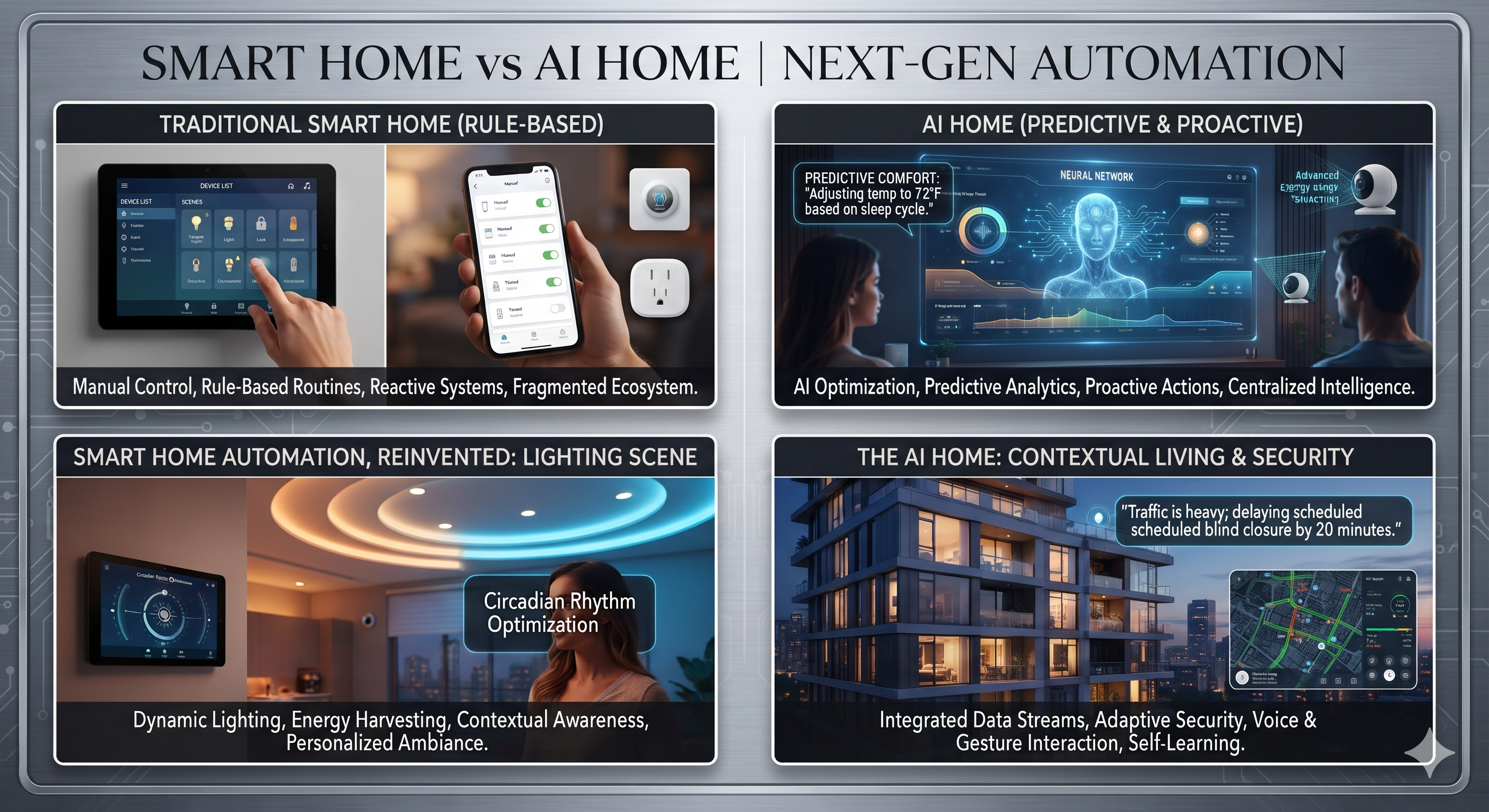
What if your home could do more than respond to commands? Imagine a living space where compatible lighting follows a schedule, climate controls adapt to changing conditions, and intelligent security devices help identify relevant events. This is the direction in which smart home technology is evolving as artificial intelligence becomes more widely integrated into residential systems.
For homeowners in Dubai and across the UAE, understanding the difference between a smart home and an AI-powered home can help when planning a new villa, upgrading an apartment, or investing in luxury home automation.
At Marvis Technology LLC, we help customers explore smart home automation, lighting control, climate integration, connected security, and audio-visual solutions designed around their property and lifestyle. Where compatible AI-enabled products are required, their capabilities can be assessed as part of the wider system design.
What Is a Smart Home?
A smart home uses connected devices, controllers, sensors, and software to let residents control and automate different household functions. These systems can be operated through a mobile application, wall-mounted touch panel, compatible voice assistant, remote control, or configured schedule.
For example, a smart home can be configured to switch off selected lights when you leave, close motorized curtains at a scheduled time, or activate a customised scene with a single command.
Common smart home features include:
- Smart lighting, dimming, and lighting scenes.
- Motorized curtains, blinds, and shades.
- Compatible air-conditioning and climate controls.
- Centralised control panels and mobile applications.
- Home cinema and multi-room audio integration.
- Connected CCTV, sensors, and access-control systems.
- Scheduled routines and predefined automation rules.
A conventional automation system generally follows the rules and schedules configured for it. It can be highly convenient and reliable without needing artificial intelligence.
What Is an AI-Powered Home?
An AI-powered home uses artificial intelligence in supported devices or platforms to analyse information, recognise patterns, classify events, or assist with decisions. Depending on the product, AI may help a system respond to changing conditions rather than relying only on fixed schedules.
For example, a compatible AI-enabled security camera may distinguish between people, vehicles, and other movement. A supported climate-control platform may use occupancy information or learned preferences to help optimise settings. An AI assistant may also interpret natural-language requests to control compatible devices.
Possible AI-enabled functions include:
- AI-based person or vehicle detection in supported security cameras.
- Occupancy analysis using compatible sensors and software.
- Adaptive recommendations based on available usage data.
- Natural-language interaction through supported assistants.
- Intelligent event filtering and notifications.
- Data-driven energy-management recommendations.
Important distinction: Not every smart home is an AI home, and not every device marketed as AI can learn household routines. Capabilities vary by model, platform, software, and configuration. Some features require cloud connectivity, while others can operate locally.
Smart Home vs AI Home: What Is the Difference?
| Feature | Smart Home | AI-Powered Home |
|---|---|---|
| How it operates | Uses commands, schedules, triggers, and predefined rules. | May use AI to interpret information, recognise patterns, or adapt supported functions. |
| Lighting | Activates scenes based on configured schedules or commands. | May use supported occupancy or contextual analysis to inform lighting behaviour. |
| Security | Records footage and sends configured motion alerts. | Compatible AI cameras may classify people, vehicles, or other events. |
| Climate control | Follows selected temperature settings and schedules. | Supported systems may use occupancy data or predictive features to adjust operation. |
| Personalisation | Uses scenes and preferences configured by the homeowner. | May generate recommendations or adapt supported functions using available data. |
| Internet dependency | Depends on the architecture; some functions operate locally. | Also depends on the architecture; some AI features require cloud services, while others run locally. |
| Human control | Residents configure and activate automation rules. | Residents can review permissions and decide which AI-assisted actions are allowed. |
The two approaches are not competitors. In many installations, traditional automation provides predictable control while AI-enabled devices add useful intelligence to specific tasks.
1. Intelligent Lighting That Fits Your Lifestyle
Lighting is one of the most practical places to begin building a connected home. Smart lighting can provide scheduled operation, dimming, grouped controls, and customised scenes. When compatible sensors or AI-enabled platforms are available, additional contextual features may be possible.
Imagine a Dubai villa with separate lighting settings for the living room, kitchen, bedrooms, and outdoor areas. A resident could activate a welcome scene, select a relaxing evening setting, or dim compatible lights for a movie night.
Depending on the selected equipment, lighting automation may support:
- Preconfigured scenes for different activities.
- Scheduled switching and dimming.
- Occupancy-based lighting through compatible sensors.
- Integration with motorized curtains and entertainment.
- Centralised control through supported panels or applications.
AI is not required for every lighting function. A well-designed rule-based system can deliver excellent results, while AI-enabled features can be considered where they provide a clear additional benefit.
Explore our smart lighting automation services in the UAE.
2. AI-Enabled Home Security and Smarter Monitoring
Home security is one area where AI can provide practical advantages. Traditional CCTV systems can record video and detect movement, while compatible AI-enabled cameras may analyse video to distinguish relevant objects or events.
Depending on the equipment, these functions may help users:
- Receive alerts for detected people or vehicles.
- Reduce some unnecessary notifications caused by irrelevant movement.
- Review selected events more efficiently.
- Monitor designated entrances and outdoor areas.
- Integrate supported camera events with other systems.
AI detection is not infallible. Camera placement, lighting, environmental conditions, model capabilities, and configuration can affect performance. Security decisions should not rely solely on AI classifications where independent verification is necessary.
For projects in Dubai, relevant CCTV and security installations may be subject to SIRA requirements. These requirements must be checked for the specific property and project. AI features do not automatically make a camera or complete security installation SIRA approved.
Discover our CCTV installation services in Dubai and smart safety and security solutions.
3. Climate Control That Supports Everyday Comfort
Maintaining comfortable indoor temperatures is an important consideration in the UAE. Smart climate integration can help homeowners schedule compatible air-conditioning systems and manage selected settings through centralised controls.
Depending on the supported HVAC equipment and platform, more advanced functions may use occupancy information, environmental data, or usage patterns to recommend or adjust selected settings.
Potential benefits include:
- Schedules that reflect daily routines.
- Centralised control of compatible climate zones.
- Integration with selected home scenes.
- Remote adjustments through supported applications.
- Energy-management insights where suitable monitoring is available.
Actual comfort and energy results depend on the HVAC system, building insulation, occupancy, weather, and settings. AI-based climate features require appropriate equipment and should not be assumed to work with every air-conditioning unit.
4. Personalised Scenes and Adaptive Automation
Traditional automation allows you to define exactly what happens when a scene is activated. AI-enabled systems may add recommendations or adaptive functions when they can access relevant data and support the required integration.
Consider these examples:
Welcome Home
A configured scene can activate selected lights and set compatible climate controls when you arrive or issue a command. If supported presence detection is integrated, the system may also use occupancy information as a trigger.
Movie Night
A single command can dim compatible lighting and prepare connected entertainment equipment. This is usually a predefined automation scene; AI is not necessary for it to work.
Good Night
A configured routine can switch off selected lights, close compatible curtains, and activate designated security settings.
Adaptive Suggestions
Some AI-enabled platforms can analyse recurring usage patterns and suggest changes. Whether the platform actually learns, how it processes data, and whether a homeowner must approve changes depend on the product.
For reliability and user confidence, important actions such as access control and security arming should have clearly defined permissions and safeguards.
Learn more about our smart scenes and automation solutions.
5. Voice Control and Natural-Language Interaction
Voice control gives residents another way to interact with their homes. Supported assistants can interpret commands such as adjusting lights, changing selected settings, or activating a compatible scene.
AI-based language processing may make interactions more flexible, but the assistant still needs to understand the request and communicate with supported devices or automation platforms.
Before selecting a voice-control system, check:
- Compatibility with the home automation platform.
- Supported languages and regional availability.
- Which devices and functions can be controlled.
- Whether internet connectivity is required.
- Microphone permissions, privacy settings, and data handling.
Voice control is an interface, not proof that the entire home is AI-powered. A well-integrated system can combine voice commands with reliable scenes, touch panels, and physical controls.
Explore our voice-control smart home solutions.
6. Smart Entertainment and Connected Living
Home entertainment can become easier to manage when compatible audio-visual devices are integrated with the wider automation system. Residents may use a supported controller or scene to prepare the television, home theatre, audio zones, and selected lighting.
AI-enabled entertainment features may be available through particular products, but many useful functions—such as multi-room audio, source selection, and cinema scenes—are based on conventional automation.
The priority should be reliable device compatibility, clear controls, suitable networking, and an experience that fits the household.
Explore our multi-room audio solutions and home theatre and video systems.
7. Energy Management and More Informed Decisions
Smart automation can help residents manage the operation of lighting and climate systems. AI-enabled products may offer additional analysis or recommendations when suitable consumption data and control interfaces are available.
Possible approaches include:
- Scheduling compatible systems around occupancy and routines.
- Using sensors to reduce unnecessary operation of selected lights.
- Monitoring energy consumption with compatible meters or software.
- Reviewing trends to identify potential areas for improvement.
AI does not guarantee lower electricity bills. The outcome depends on existing equipment, building conditions, user behaviour, data quality, and the settings applied.
8. Wired, Wireless, and Hybrid Automation for Modern Homes
Whether you choose conventional smart automation or add AI-enabled features, the underlying infrastructure matters. The right design should consider the property layout, network reliability, device compatibility, and future expansion plans.
- Wired automation: Often considered for new builds and major renovations where infrastructure can be planned in advance.
- Wireless automation: Can suit existing homes where extensive rewiring is impractical. Performance depends on coverage, interference, and supported protocols.
- Hybrid automation: Combines wired and wireless technologies where appropriate to meet project requirements.
AI functions may operate on a device, on a local controller, or through cloud services. Ask how the selected system behaves if internet access is lost, which features continue to work locally, and what information is sent outside the property.
9. Privacy, Cybersecurity, and Homeowner Control
Connected homes may process information about occupancy, device usage, security events, or household routines. AI features can introduce additional questions about how data is analysed, stored, and shared.
Before installing an AI-enabled system, consider:
- Whether processing occurs locally or in the cloud.
- What information is collected and how long it is retained.
- Who can access recordings, usage data, and system settings.
- How user accounts, passwords, and remote access are protected.
- Whether the manufacturer provides security updates.
- How the system behaves when internet or cloud services are unavailable.
Keep devices updated, use strong credentials, restrict unnecessary access, and review privacy settings. Where possible, choose systems that explain their data practices and allow residents to control important settings.
10. How to Choose the Right Home Automation Solution in Dubai
The best solution is not necessarily the one with the most AI features. It is the system that solves your actual needs, integrates reliably, and remains manageable over time.
- List your priorities: Decide whether you need lighting, curtains, climate control, security, entertainment, or a combination of functions.
- Assess your property: Review existing wiring, network coverage, room layout, and construction stage.
- Separate essential automation from optional AI: Identify which functions need predictable rules and where AI would provide measurable value.
- Check compatibility: Confirm the exact device models, interfaces, supported platforms, and required integrations.
- Review privacy and reliability: Understand local operation, cloud dependency, data policies, and recovery procedures.
- Plan for expansion: Consider future rooms, devices, and maintenance requirements.
- Request a clear proposal: Ask for the equipment, included functions, limitations, commissioning, and support arrangements to be documented.
Why Choose Marvis Technology LLC?
Marvis Technology LLC provides automation, security, networking, and audio-visual integration solutions for residential and commercial properties in Dubai and across the UAE.
Our services can include:
- Smart home automation planning and integration.
- Smart lighting and customised scenes.
- Compatible HVAC and climate-control integration.
- Motorized curtains and blind control.
- CCTV and security system integration, subject to applicable requirements.
- Networking infrastructure for connected devices.
- Home theatre and multi-room audio integration.
- Integration planning for supported AI-enabled devices and platforms.
We focus on the requirements of each project and the compatibility of the proposed equipment. AI-enabled features should be confirmed against the specific products and platforms selected rather than assumed to be available across every installation.
Frequently Asked Questions
What is the difference between a smart home and an AI home?
A smart home generally uses connected devices and predefined automation rules. An AI-powered home adds supported artificial intelligence features that can analyse information, recognise patterns, classify events, or assist with decisions. Many homes combine both approaches.
Does an AI home automatically learn my daily routine?
Not necessarily. Learning capabilities depend on the specific product and software. Some platforms provide recommendations or adaptive features, while others rely on schedules and rules that residents configure manually.
Can I upgrade my existing Dubai villa to AI-enabled automation?
Potentially, yes. The available options depend on existing infrastructure, compatible devices, network coverage, and the AI features you want to use. A technical assessment can help determine the most suitable approach.
Does AI home automation work without the internet?
Some AI and automation functions can operate locally, while others require cloud connectivity. Check the product specifications to understand which features continue to work during an internet outage.
Can AI make my home more secure?
Compatible AI-enabled cameras and monitoring systems can help classify events and improve alert relevance. Their performance depends on the device and environment, and they should be used alongside appropriate security procedures rather than treated as a guarantee of safety.
Is AI home automation more expensive than a smart home?
Costs depend on the equipment, AI features, integration complexity, infrastructure, and installation requirements. Some AI features are built into individual devices, while others may require additional hardware, software, or subscriptions.
Is every AI-enabled CCTV system SIRA approved in Dubai?
No. AI capability does not automatically establish SIRA approval. Relevant security installations must be assessed against the applicable requirements for the project, equipment, and service provider.
Experience the Next Generation of Home Automation
Smart home automation makes everyday control more convenient, while AI-enabled technology can add useful analysis, event recognition, and adaptive features where supported. The strongest design combines reliable automation with carefully selected intelligent capabilities, clear homeowner control, and attention to privacy and security.
Planning a smart home or AI-enabled villa automation project in Dubai or across the UAE? Contact Marvis Technology LLC to discuss your requirements and explore the right combination of smart home technologies for your property.
WhatsApp: Request a smart home consultation on WhatsApp
Phone: +971 54 740 3829
Email: sales@marvistechno.com
Location: Dubai, United Arab Emirates