2026-08-26
Discover how SIRA-compliant CCTV, gate barriers, ANPR, access control and intelligent security systems can help hospitals in Dubai build safer, smarter and better-connected healthcare facilities.
Hospitals require a higher level of security than many other commercial facilities. Every day, hospitals manage patients, doctors, nurses, visitors, emergency vehicles, ambulances, employees, contractors, suppliers and service vehicles. This makes professional surveillance, controlled vehicle access and reliable security infrastructure essential for modern healthcare facilities in Dubai.
For hospitals and healthcare facilities in Dubai, CCTV should not be treated simply as a collection of security cameras. A complete security solution may include CCTV surveillance, access control, automatic gate barriers, ANPR, visitor management, intercom systems, security alarms, networking infrastructure, monitoring systems and integrated building automation.
Where SIRA requirements apply, the security system must be designed and implemented according to the applicable regulatory requirements, project category and approved security plan.
Marvis Technology provides integrated security, automation, networking and smart-building solutions for modern UAE projects, including new construction and retrofit environments.
Explore IP CCTV Security Camera Systems in UAE
The Security Industry Regulatory Agency (SIRA) regulates private security activities and security systems in Dubai. Its regulatory framework covers areas including security systems, security equipment, security plans and related technical requirements.
For a hospital project, SIRA compliance should be considered during the security planning and design stage rather than after CCTV and access-control equipment has already been installed.
The exact requirements applicable to a healthcare facility depend on the project, building classification, activities, security plan and current regulations. Therefore, hospitals should confirm the applicable requirements with SIRA and qualified security-system professionals before implementation.
View SIRA Security Plans Certification Information
A hospital has multiple security zones with different levels of access. The main entrance may be open to patients and visitors, while emergency departments, pharmacies, laboratories, operating areas, server rooms, medical stores and staff-only areas require controlled access.
A standalone CCTV system cannot control who enters a restricted area. Similarly, a gate barrier without surveillance cannot provide complete visual verification of vehicle movements.
Integrating CCTV with gate barriers, ANPR and access control creates a more complete security ecosystem.
A hospital CCTV system should be designed around the facility's security objectives and operational requirements. Hospitals can contain hundreds of rooms and multiple buildings, making camera placement and network infrastructure particularly important.
Depending on the hospital layout and applicable requirements, surveillance planning may include:
Camera locations should always be determined through a professional security survey and the applicable regulatory and privacy requirements.
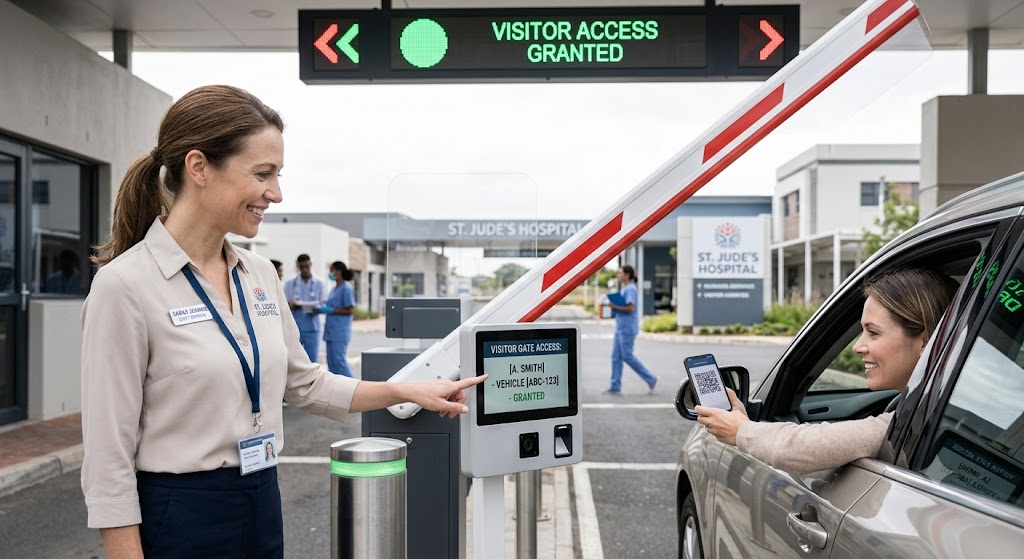
Gate barriers provide controlled vehicle access to hospital premises. They can be installed at main entrances, staff parking areas, service entrances, visitor parking and other controlled vehicle zones.
A modern hospital gate barrier system can integrate:
The objective is to create a controlled and monitored vehicle entrance without unnecessarily slowing legitimate hospital traffic.
Automatic Number Plate Recognition, commonly known as ANPR, can be used to identify vehicle registration plates and support intelligent vehicle access management.
When ANPR is integrated with a gate barrier, the system can identify authorized vehicles and send an access command to the barrier according to the configured access rules.
For example, an approved staff vehicle may be recognized at the entrance and automatically permitted to enter, while an unknown vehicle can be directed to a security checkpoint.
ANPR can be particularly useful for:
The real strength of an intelligent hospital security system comes from integration.
Instead of operating the CCTV system and gate barrier as independent technologies, they can be designed as part of a connected security infrastructure.
A typical workflow can operate as follows:
This creates better visibility over vehicle movements while helping security teams manage access more efficiently.
Hospital entrances must accommodate emergency vehicles, particularly ambulances responding to urgent medical situations.
Gate automation should therefore be designed around the hospital's operational procedures and emergency-access requirements.
Potential technologies include:
The final configuration should always be determined by the hospital's security team, project engineers and applicable regulations so that emergency access is never unnecessarily obstructed.
The hospital perimeter is an important part of the overall security architecture.
Perimeter surveillance can help security teams monitor:
Outdoor cameras should be selected according to the installation environment, lighting conditions, weather exposure and applicable technical requirements.
Large hospitals require a strong IT and network infrastructure to support hundreds of connected security devices.
An IP CCTV architecture may include:
Network design should consider bandwidth, redundancy, cybersecurity, storage capacity, power requirements and future expansion.
For hospital projects requiring networking equipment, servers, storage, CCTV hardware and other IT infrastructure products, Marvis Digital provides an e-commerce platform for technology products.
Explore IT, CCTV, Networking & Infrastructure Products at Marvis Digital
Security equipment selection is an important part of a regulated security-system project. SIRA provides a certification process for security equipment and devices used within security systems.
Depending on the project and equipment category, the required certification and approval process should be confirmed before equipment procurement and installation.
Hospitals should avoid selecting equipment solely on price or megapixel count. The equipment should be evaluated based on technical performance, environmental requirements, interoperability, recording requirements, cybersecurity and regulatory compatibility.
Learn About SIRA Security Equipment and Devices Certification
Artificial intelligence is increasingly being incorporated into modern video surveillance systems.
AI video analytics can help security teams process large amounts of surveillance footage and identify specific events more efficiently.
Depending on the approved technology and project requirements, AI CCTV can support functions such as:
AI should complement—not replace—proper security planning, camera positioning, recording infrastructure, trained security personnel and applicable regulatory requirements.
Hospitals have many areas where access needs to be restricted.
Examples include:
Access-control systems can use credentials such as cards, PINs, biometrics or other approved identification technologies.
When access control is integrated with CCTV, security teams can associate access events with corresponding video footage, providing better situational awareness.
Explore Smart Safety & Security Systems
Smart door locks can provide controlled access to selected areas of a hospital when designed as part of an appropriate access-control architecture.
Depending on the project, systems can support centralized authorization, credential management and monitoring.
However, critical healthcare doors and emergency routes require careful engineering. Any access-control solution must comply with applicable fire-life-safety, healthcare, building and security requirements.
Hospitals can receive a large number of visitors every day. Visitor management can therefore form an important part of a comprehensive security strategy.
A connected visitor management system can work alongside:
This can help hospitals establish clearer visibility over visitor movement while improving the experience at reception and security checkpoints.
A centralized security control room provides hospital security personnel with a single location for monitoring critical security systems.
A professional security control room may include:
The control room should be designed according to the hospital's operational requirements, security staffing and project architecture.
Hospitals can generate significant quantities of surveillance video because of the large number of cameras and continuous operation.
Storage planning should consider:
A professional system should be designed so that the recording infrastructure can support the required operational and regulatory objectives.
Hospitals operate 24 hours a day and contain different security zones with different operational requirements.
An office building may have a relatively straightforward entrance, reception, parking and corridor layout. A hospital can have emergency departments, ambulances, pharmacies, laboratories, clinical areas, service entrances, medical storage and multiple buildings.
Therefore, hospital security requires a more detailed approach to:
Healthcare environments involve sensitive personal information and activities. CCTV design should therefore be carefully coordinated with applicable privacy, healthcare and regulatory requirements.
Security cameras should be positioned for legitimate security purposes and should avoid unnecessary monitoring of private areas.
Audio recording should not be enabled simply because a camera supports a microphone. Hospitals should confirm the applicable requirements before enabling audio surveillance.
The best time to plan hospital security infrastructure is during the design and construction stage.
Early coordination allows CCTV and gate barrier infrastructure to be integrated into:
Planning during construction can also reduce visible cabling and minimize expensive modifications after walls and ceilings are completed.
Explore Professional WiFi and Network Infrastructure Solutions
Security systems require continuous maintenance to remain reliable.
A preventive maintenance program may include:
Regular maintenance helps identify failures before they affect hospital security operations.
Hospitals should avoid treating CCTV installation as a simple equipment procurement project.
Common mistakes include:
Marvis Technology provides integrated technology solutions for modern UAE properties, including healthcare facilities, commercial buildings, hospitality projects, educational institutions and luxury developments.
Our technology capabilities include:
Explore Smart Safety & Security Solutions
A hospital is a complex environment. CCTV alone cannot provide complete security.
A properly integrated solution can connect surveillance, vehicle access, access control, visitor management, networking and automation into one coordinated technology ecosystem.
This approach can provide hospital security teams with better visibility, centralized management and improved operational control.
Hospitals and other facilities in Dubai must comply with the security requirements applicable to their specific facility and project. Where SIRA requirements apply, the CCTV system and related security infrastructure should be designed and implemented according to the applicable SIRA regulations, standards and approved security plan.
Yes. CCTV can be integrated with automatic gate barriers, ANPR, access control and intercom systems to create a coordinated vehicle-security solution.
ANPR can be incorporated into vehicle access systems where appropriate. The exact application, equipment and regulatory requirements should be confirmed for the specific project.
AI video analytics can be used as part of an intelligent surveillance architecture where appropriate and compliant. The selected analytics should support the hospital's security objectives and applicable regulatory and privacy requirements.
Yes. Existing facilities can undergo retrofit projects involving IP cameras, recording systems, network upgrades, ANPR, gate barriers, access control and intelligent video analytics.
IP cameras and other security devices rely on network infrastructure for communication. Large hospitals require properly planned bandwidth, PoE, switching, fiber backbone, cybersecurity and storage infrastructure.
Hospital security requires more than cameras at the entrance. A modern healthcare facility needs a coordinated approach that combines surveillance, controlled vehicle access, gate barriers, ANPR, access control, networking, monitoring and intelligent security technologies.
SIRA requirements should be considered from the earliest stage of hospital security planning, particularly for new construction and major retrofit projects. Proper planning helps ensure that security infrastructure is integrated into the building rather than added as an afterthought.
With the right combination of CCTV, gate barrier automation, ANPR, access control and network infrastructure, hospitals can build a more connected and intelligently managed security environment.
Marvis Technology provides integrated CCTV, security, automation, networking and smart-building solutions for healthcare, commercial, hospitality, educational and residential projects across the UAE.
Explore Integrating CCTV with Gate Barriers
Explore Visitor Digital Log Book Integration
Explore Automatic Number Plate Recognition (ANPR)
For CCTV cameras, networking equipment, servers, storage, IT infrastructure and related technology products, visit:
Marvis Digital – IT & Technology Products in UAE
This article is provided for general informational and SEO purposes and should not be considered legal, regulatory or engineering advice. SIRA requirements may vary according to facility type, project scope, building classification, security plan and current regulations. Hospitals and project stakeholders should verify the latest requirements with SIRA and work with appropriately qualified and authorized security-system professionals for security planning, equipment selection, installation, certification and compliance.
Need help with smart home automation or security? Our experts are ready to assist you.
Fill out the form and we’ll get back to you.