
2026-11-05
Planning smart lighting for your villa in Dubai? Compare KNX and wireless lighting control technologies, including installation requirements, reliability, flexibility, scalability, integration and long-term costs, to choose the right solution for your property.
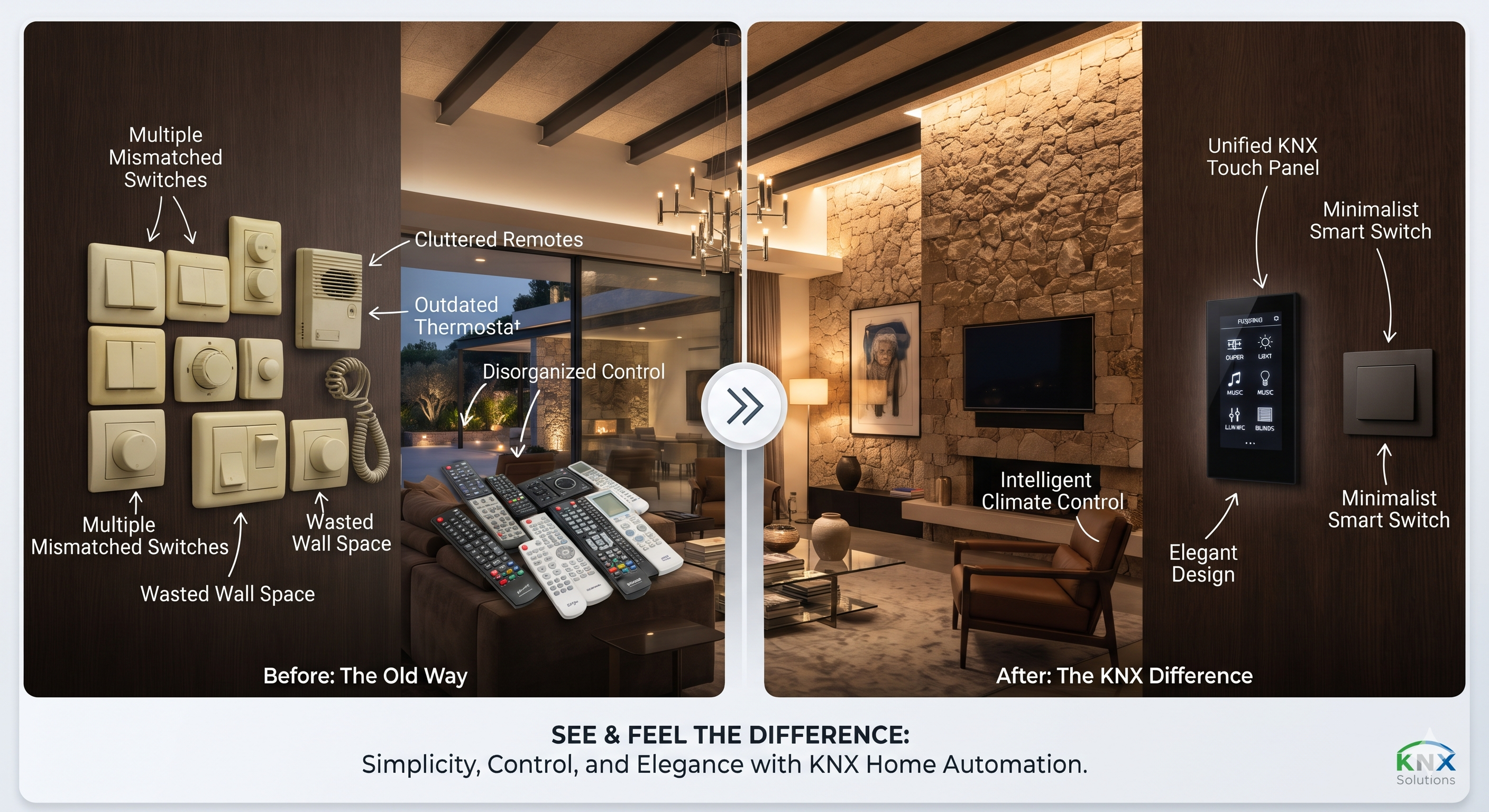
Planning a smart villa? Your lighting control system deserves careful consideration. From controlling bedroom lights with a single touch to creating personalised scenes for entertaining guests, modern lighting automation can make everyday living more convenient, comfortable and energy-conscious.
But when choosing a lighting automation system for a villa in Dubai, one important question often comes up: should you choose KNX wired automation or wireless lighting control?
Both technologies can deliver intelligent lighting experiences, but they differ in installation methods, infrastructure requirements, flexibility and long-term planning. The right choice depends on your villa's construction stage, lighting requirements, budget and future automation plans.
In this guide, Marvis Technology LLC compares KNX and wireless lighting control to help you make an informed decision for your home in Dubai or anywhere in the UAE.
KNX is an internationally recognised standard for building automation. It allows compatible devices such as lighting actuators, sensors, switches, controllers and other building systems to communicate through a shared automation infrastructure.
In a typical KNX lighting installation, control devices communicate over a dedicated bus cable, commonly KNX TP, while the lighting circuits are connected through appropriate switching or dimming actuators.
This allows homeowners to control different lighting zones from wall switches, touch panels, sensors, central controllers or compatible smart home interfaces.
Explore KNX home and building automation solutions to understand how integrated control can support modern residential and commercial properties.
Wireless lighting control uses radio-based communication technologies to connect smart switches, lighting controllers, sensors, gateways and other compatible devices without requiring a dedicated wired bus connection between every control point.
Depending on the system, wireless communication may use technologies such as Zigbee, Bluetooth Mesh, Wi-Fi or proprietary radio protocols.
Some wireless systems operate through a central hub or gateway, while others allow compatible devices to communicate directly or through a mesh network.
Wireless does not necessarily mean completely cable-free. Lighting fixtures, controllers and gateways may still require electrical power, and the installation must follow appropriate electrical and safety requirements.
Both systems can support intelligent lighting, but their technical architecture and installation requirements are different.
| Comparison | KNX Lighting Control | Wireless Lighting Control |
|---|---|---|
| Communication | Commonly uses a dedicated KNX bus cable | Uses radio-based communication |
| Installation | Requires planned automation wiring and suitable actuators | Can reduce the need for additional control wiring |
| Best project stage | Especially suitable during new construction or major renovation | Often convenient for existing homes and retrofit projects |
| Reliability factors | Dedicated bus infrastructure and correct system design | Radio coverage, interference, network design and device quality |
| Expansion | Can be expanded through planned system design and compatible devices | Can be expanded with compatible wireless devices and gateways |
| Integration | Supports a broad range of standardised building automation applications | Depends on supported protocols, gateways and product ecosystems |
| Maintenance | Requires appropriate configuration and technical support | May involve battery replacement, firmware updates and wireless troubleshooting |
| Initial investment | Can involve higher upfront infrastructure and installation costs | May be more economical for smaller or targeted upgrades |
Actual performance and cost depend on the selected products, property layout, installation quality and project requirements. Not every KNX or wireless system offers identical features.
KNX is particularly attractive when automation is considered during the villa's design or construction stage. The electrical and automation infrastructure can be planned together, allowing bus cabling, distribution boards, actuators and control points to be positioned appropriately.
This planning can make it easier to coordinate lighting, sensors, switches and other building automation functions within a structured system.
Wireless lighting control can be convenient when upgrading an existing villa. In suitable installations, wireless switches, controllers and sensors can reduce the need to open walls or install additional control cables.
However, the installer still needs to assess radio coverage, wall construction, device placement, electrical wiring and gateway requirements.
Which is better? KNX is often a strong option for new villas and major renovations. Wireless control can be practical when upgrading selected rooms or lighting circuits in an already completed property.
Reliability is important in a villa where lighting automation may be used throughout the day and night.
KNX wired installations use a dedicated communication bus, which avoids relying on Wi-Fi coverage for communication between KNX bus devices. Proper cabling, configuration, power supply and commissioning remain essential.
Wireless systems can also perform reliably when designed correctly. Their performance depends on radio coverage, device placement, network congestion, interference and the communication technology being used.
For larger villas with thick walls, multiple floors or extensive outdoor areas, wireless coverage should be assessed before installation. Additional gateways or repeaters may be necessary, depending on the selected system.
Important: A wired system is not automatically better in every situation, and wireless does not automatically mean unreliable. Proper engineering and product selection matter more than choosing a technology based on assumptions.
The cost of a smart lighting project depends on the number of lighting circuits, selected switches, dimming requirements, control panels, wiring, actuators, gateways, programming and installation complexity.
Wireless may reduce infrastructure costs for a small retrofit, while KNX may provide better long-term value for a large villa with extensive automation requirements. A detailed project quotation is the best way to compare the total investment.
Villa owners often want more than simple light switching. They may want lighting to work with motorised curtains, air conditioning, occupancy sensors, security systems and entertainment areas.
KNX is designed for building automation and offers a broad ecosystem of compatible devices. With suitable interfaces and system configuration, lighting can become part of a wider automation environment.
Wireless systems can also support integrated experiences, but compatibility depends on the specific protocol, controller, gateway and device models.
For example, a homeowner may create a Good Night scene that switches off selected lights, closes compatible curtains and adjusts other connected devices. The exact functions depend on how each system is integrated.
Explore these Marvis Technology services:
For large villas with multiple floors, numerous lighting zones, landscape lighting and integrated automation requirements, KNX can be a strong choice. Its structured architecture supports coordinated control across different areas of the property.
If your villa is still in the planning or construction stage, KNX should be considered early. This allows the automation infrastructure to be coordinated with electrical layouts and interior design.
Wireless lighting control can be attractive for completed villas where extensive rewiring would be disruptive. It can support selected upgrades without requiring a complete redesign of the electrical infrastructure.
A wireless solution may be sufficient when the requirements involve a limited number of rooms, smart switches and basic lighting scenes. A wired system may still be appropriate if the owner wants a wider automation platform.
Yes. A hybrid automation approach can combine KNX infrastructure with compatible wireless devices through suitable gateways or integration interfaces.
For example, a villa may use KNX for primary lighting circuits and selected building automation functions while wireless devices provide additional controls in areas where installing new cables is inconvenient.
However, hybrid integration requires careful planning. Not every wireless protocol or product can communicate directly with KNX. The selected gateway must support the required functions, and the installer should confirm compatibility before procurement.
A well-designed hybrid system can offer flexibility without compromising the overall automation architecture.
Before selecting KNX or wireless lighting control, consider these practical questions:
A smart lighting system should be designed around your villa, lifestyle and future requirements rather than simply adding smart devices to individual rooms.
Marvis Technology LLC provides smart home and building automation solutions in Dubai and across the UAE. Our automation services can be planned around project requirements, including lighting control, KNX integration, smart scenes, motorised curtains and wider residential automation.
Whether you are building a new villa or upgrading an existing property, the right system selection begins with understanding your electrical infrastructure, lighting layout and desired level of control.
Our team can help assess your requirements and discuss suitable automation options for your project.
Neither is universally better. KNX is often suitable for large villas, new construction and extensive building automation. Wireless control can be convenient for existing properties and smaller upgrades. The best choice depends on project requirements.
KNX can provide reliable communication through its dedicated bus infrastructure when correctly designed, installed and commissioned. Overall performance also depends on compatible devices, electrical design and maintenance.
Yes, wireless lighting control can be suitable for many existing villas. The installer should assess electrical compatibility, radio coverage, device placement and gateway requirements before installation.
Typical KNX TP installations use a dedicated bus cable for communication between KNX devices. The lighting circuits and power distribution also need to be designed to suit the selected actuators and control architecture.
Yes, KNX can coordinate compatible curtain motors, HVAC interfaces, sensors and other building systems when the required devices and interfaces are available and correctly configured.
Some wireless lighting technologies use protocols such as Zigbee or Bluetooth Mesh rather than Wi-Fi. Their operation depends on the selected system architecture, devices and controller. Remote app access may require an internet connection or gateway.
A future upgrade may be possible, but it can require additional wiring, replacement of devices, new actuators and system reconfiguration. Planning for future automation before installation can help reduce upgrade complexity.
KNX and wireless lighting control both offer valuable benefits for modern villas in Dubai. KNX is a strong option for structured, large-scale automation, while wireless control can provide flexibility for selected rooms and retrofit projects. A hybrid approach may also be suitable when the project requires both technologies.
The best solution is the one that matches your property layout, construction stage, lighting requirements and long-term automation goals.
Planning smart lighting for your villa in Dubai? Contact Marvis Technology LLC to discuss KNX lighting control, wireless automation and integrated smart home solutions.
Marvis Technology LLC — Intelligent Lighting. Seamless Automation. Smarter Living.
Need help with smart home automation or security? Our experts are ready to assist you.
Fill out the form and we’ll get back to you.