2026-11-02
Learn how to choose a reliable home automation and security provider in Dubai. Understand SIRA requirements, verify company credentials, compare CCTV and access control solutions, and evaluate smart home integration.
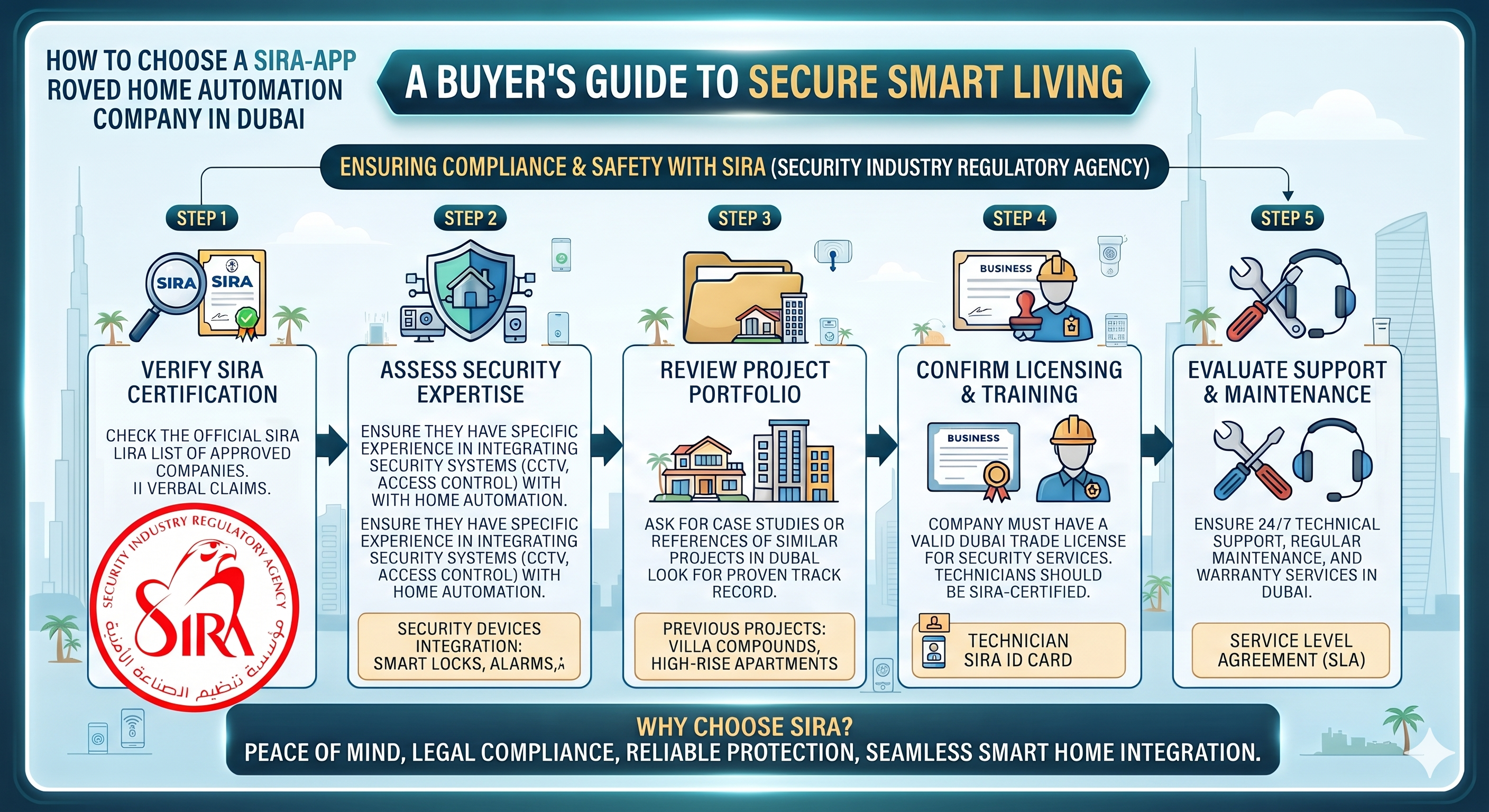
Choosing a home automation company in Dubai involves more than comparing prices and smart devices. If your project includes CCTV surveillance, access control, or other regulated security systems, you should also understand the relevant Security Industry Regulatory Agency (SIRA) requirements.
From smart lighting and motorized curtains to CCTV cameras, biometric access control, and integrated security, the right provider should understand both technology and the requirements of your property.
But how do you identify a suitable company? What does SIRA approval actually mean? And what should you verify before signing an installation agreement?
This guide from Marvis Technology LLC explains the important factors to consider when choosing a home automation and security solutions provider in Dubai and across the UAE.
SIRA stands for the Security Industry Regulatory Agency, the authority responsible for regulating relevant security activities in Dubai.
Depending on the nature of a project, applicable requirements may cover security companies, technical personnel, equipment, installation activities, and project compliance.
For customers planning CCTV or other regulated security installations, checking the relevant credentials is an important part of selecting a provider.
However, there is an important distinction: a company licence, a product approval, an individual technician's qualification, and project-specific compliance are not necessarily the same thing.
Do not assume that every smart home product or automation device is automatically SIRA-approved simply because it is included in a smart home installation.
Before choosing a provider, ask which licences, registrations, approvals, or qualifications apply to the specific work you need.
Consider checking:
Where applicable, verify credentials through official SIRA channels rather than relying only on marketing statements or verbal assurances.
Home automation and security systems require different technical considerations. A provider may be experienced in lighting or curtain automation but may not necessarily have the relevant experience for regulated CCTV or access control projects.
If your project includes security systems, look for experience in the following areas:
Ask whether the company can plan camera positions, coverage areas, recording requirements, storage, network connectivity, and remote viewing.
Explore CCTV installation solutions in Dubai for surveillance requirements across residential and commercial properties.
Access control helps manage entry to selected doors, rooms, and restricted areas. Depending on the project, solutions may include card readers, biometric devices, PIN-based access, and other compatible technologies.
Learn more about Biometric & Access Control Solutions in the UAE.
For villas, residential communities, and commercial properties, automatic barriers can help manage vehicle entry and exit. The design should consider access permissions, safety sensors, traffic flow, and integration requirements.
Explore automatic gate and barrier solutions.
Automatic Number Plate Recognition (ANPR) can help identify registered vehicle plates, while biometric access control can authenticate authorised users using supported biometric credentials.
Explore ANPR solutions and Visitor Digital Log Book Integration.
A home automation provider should understand how different systems can work together, not just how to install individual smart devices.
Depending on your requirements, consider whether the company can design and integrate:
Explore smart home automation solutions in the UAE to understand the different functions that can be included in a connected home.
One of the most important factors when choosing a home automation company is its ability to select compatible equipment.
Smart home devices may use different communication technologies and protocols. Not every motor, switch, sensor, camera, or controller works with every platform.
Ask your provider:
For projects involving professional automation platforms, ask about the specific equipment, programming, integration requirements, and supported features.
For example, explore Honeywell KNX home and building automation for compatible building-control applications.
A reliable provider should be able to explain its technical approach and demonstrate relevant project experience.
Before making a decision, consider asking for:
Do not evaluate a provider based only on photographs or promotional material. Ask how the system was designed, configured, tested, and handed over.
Two companies may quote different prices for what appears to be the same installation. The difference may come from equipment quality, technical specifications, installation scope, integration, or after-sales support.
Review the following items in each quotation:
A clear quotation helps you understand exactly what is included and reduces the risk of unexpected costs during installation.
Installing a smart home or security system is only the beginning. Equipment may require software updates, maintenance, troubleshooting, or configuration changes over time.
Before selecting a company, ask about:
For CCTV and access control, ongoing maintenance is particularly important because poorly maintained equipment can affect system reliability.
Every property has different requirements. A villa, apartment, school, office, hotel, or commercial building may need a different combination of automation and security solutions.
Consider smart lighting, motorized curtains, climate controls, CCTV, access control, gate barriers, and integrated entertainment based on your needs.
Focus on suitable lighting controls, curtains, smart security, and compatible devices that work within the property's wiring and installation limitations.
Consider surveillance coverage, controlled entry, network infrastructure, meeting-room automation, and centralized building functions.
These environments may require carefully planned surveillance, access management, monitoring, and operational controls. Applicable regulatory and project requirements should be assessed before selecting equipment and installation methods.
Use this checklist when comparing providers in Dubai:
Marvis Technology LLC provides automation, smart home, and technology infrastructure solutions for residential and commercial properties in Dubai and across the UAE.
Our service areas include:
We understand that every project has different technical and operational requirements. The right solution begins with understanding your property, identifying the required systems, and selecting suitable equipment and integration options.
Important: For projects involving regulated security activities, confirm the relevant company, personnel, product, and project approvals applicable to the proposed scope before proceeding. Do not rely on a general smart home service description as proof of regulatory authorisation.
SIRA approval generally refers to compliance with applicable requirements established by Dubai's Security Industry Regulatory Agency. The exact requirements depend on the activity, company, personnel, equipment, and project scope involved.
Not every home automation activity is necessarily regulated by SIRA. Requirements depend on the specific services being provided. Security-related activities such as regulated CCTV installation may have applicable licensing and compliance requirements.
No. Smart lighting, curtains, voice assistants, and other general automation products should not automatically be described as SIRA-approved. Product requirements depend on the device and its intended use.
Ask the company for its relevant licence or approval details and verify them through official SIRA channels. Confirm that the authorisation covers the specific service and project you require.
A provider may offer these services, but the relevant regulatory requirements must be met for the particular security activities, products, personnel, and project. Ask for documentation before appointing the provider.
A detailed quotation should identify equipment models, quantities, installation scope, wiring, programming, integration, testing, commissioning, warranty, and any applicable approval or documentation responsibilities.
Some CCTV systems can integrate with compatible smart home platforms or controllers. Available functions depend on the camera, recorder, software, integration interface, and security requirements.
Yes. Many existing properties can accommodate retrofit smart home solutions. The installation method depends on existing wiring, network connectivity, equipment compatibility, and property constraints.
Selecting a home automation company is an important decision, especially when your project includes security systems that may be subject to regulatory requirements. Look beyond marketing claims and compare relevant credentials, technical experience, product compatibility, project documentation, and long-term support.
Whether you are planning smart lighting for a villa, CCTV for a commercial building, access control for an office, or an integrated automation system, careful planning helps you make a more informed decision.
Planning a smart home or security project in Dubai? Contact Marvis Technology LLC to discuss your requirements and explore suitable automation and technology solutions.
WhatsApp: Discuss your project with our team
Call: +971 54 740 3829
Email: sales@marvistechno.com
Location: Dubai, United Arab Emirates
Need help with smart home automation or security? Our experts are ready to assist you.
Fill out the form and we’ll get back to you.