
2026-09-07
Secure and automate access with Control iD fingerprint and facial recognition readers, biometric attendance tracking and professionally integrated access control solutions for offices, commercial buildings, schools, hospitals and other facilities across the UAE.
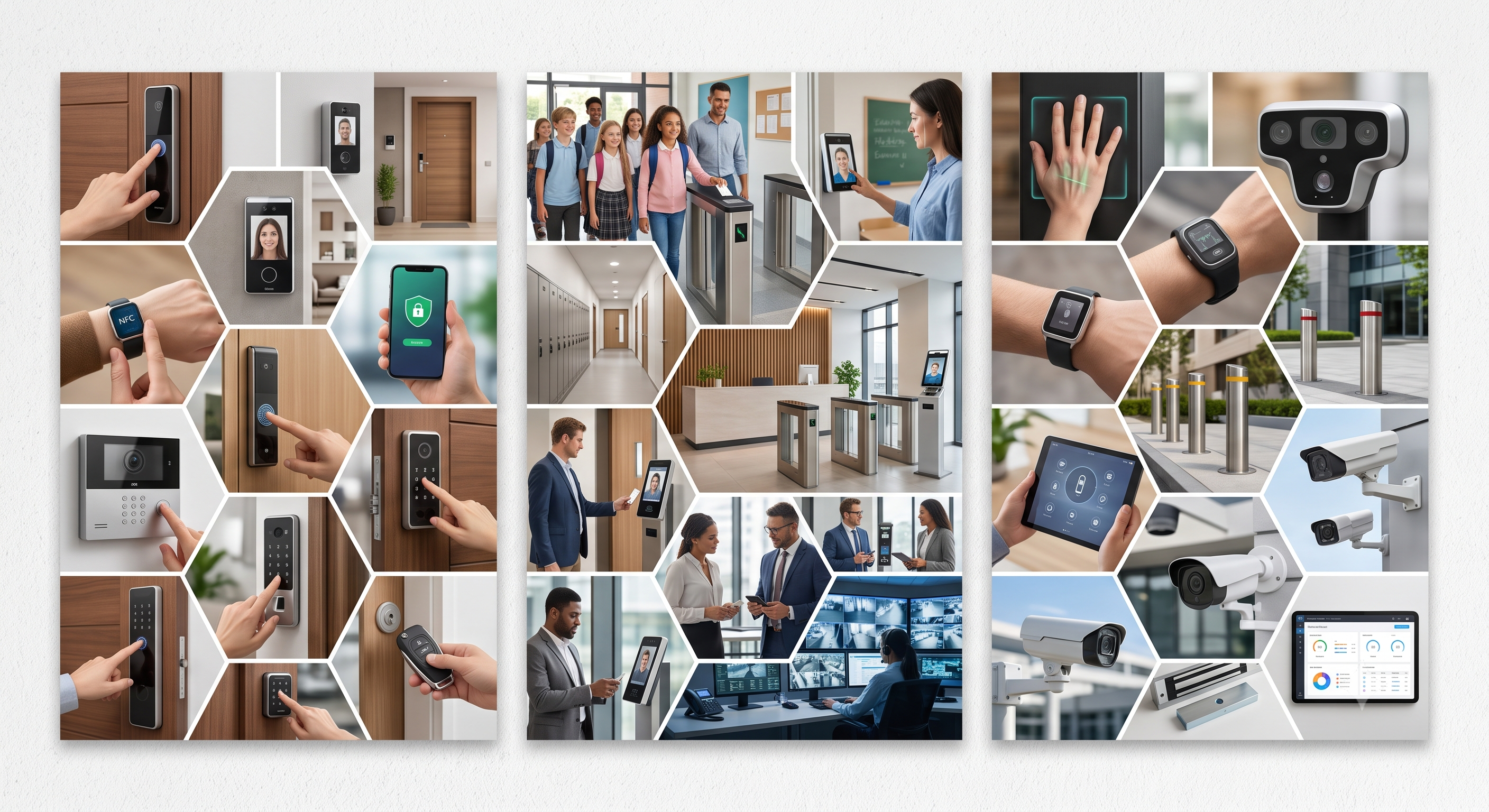
Modern buildings need more than traditional locks and keys. Businesses, offices, schools, hospitals, commercial buildings, warehouses and other facilities require secure and convenient ways to control who can enter, when they can enter and where access is permitted.
Biometric access control in the UAE provides an advanced approach to building security by using unique biometric characteristics such as fingerprints and facial recognition for user identification.
At Marvis Technology LLC, we provide professional access control and security automation solutions using advanced biometric technologies, including Control iD fingerprint and facial recognition readers, for suitable commercial and institutional applications across Dubai and the UAE.
Control iD biometric readers are part of ASSA ABLOY's digital access solutions portfolio and are designed for access control and identification applications. Depending on the model, Control iD solutions can support fingerprint or facial identification, access rules, schedules, reporting and integration with other access-control systems.
Control iD is a biometric access control technology platform designed to help organizations manage entry and exit through advanced identification methods.
Control iD solutions can combine technologies such as:
The exact capabilities depend on the Control iD model selected for the project.
Traditional keys and shared access cards can create operational challenges when organizations have large numbers of employees, contractors, visitors or authorized users.
Biometric access control provides another method of authentication by verifying an individual's biometric identity.
With a suitable biometric system, organizations can manage access to selected doors, rooms and restricted areas while maintaining records of authorized entry and exit activity.
Control iD offers biometric readers that include dedicated fingerprint and facial recognition models. ASSA ABLOY lists products such as iDAccess Pro, iDAccess Nano, iDFace and iDFace Max within its biometric reader portfolio.
Access control and employee attendance are often closely connected. A biometric reader can be used not only to authenticate authorized users at an entry point but, where supported by the system, to assist with attendance and time-management records.
This can help organizations reduce manual attendance processes and create more structured records of employee entry and exit activity.
A biometric access and attendance solution can support:
For larger organizations, the system can be designed around the organization's access hierarchy and operational requirements.
Fingerprint authentication provides a convenient way to identify authorized users without requiring a physical key.
Depending on the Control iD model, fingerprint readers can support large user databases and customized access rules.
For example, ASSA ABLOY's iDAccess Pro is designed for corporate environments and can identify up to 100,000 fingerprints in standalone mode, with access rules configurable according to groups and schedules.
This makes biometric fingerprint technology suitable for applications where organizations need structured user management and controlled access.
Facial recognition provides a contactless method of user identification and can be particularly useful at high-traffic entry points.
Control iD's facial recognition portfolio includes devices such as iDFace and iDFace Max. Depending on the model, these readers provide facial identification, touchscreen interfaces, access-rule configuration and connectivity options.
The iDFace Max, for example, supports facial identification with liveness detection and is designed for monitoring and controlling entry and exit. ASSA ABLOY states that the model can identify up to 100,000 faces on supported configurations.
These capabilities make facial recognition an attractive option for organizations looking for modern, contactless access control.
Some access-control environments require more than one authentication method.
Depending on the selected Control iD device and project configuration, authentication can incorporate different credentials such as:
Combining multiple authentication factors can provide an additional layer of protection for selected areas where stronger identity verification is required.
The appropriate authentication method should be selected according to the organization's security requirements, user experience and applicable regulations.
Security systems installed in Dubai may be subject to requirements established by the Security Industry Regulatory Agency (SIRA), depending on the application, facility and security system involved.
SIRA provides certification services for security systems and security equipment. Its current security equipment certification service states that security devices and equipment are examined according to SIRA specifications and standards for use within approved security systems.
SIRA also states that applications for security equipment approval must be submitted through a security service provider licensed by SIRA and that products must comply with applicable Preventive Systems Guidelines.
For this reason, a professional access control project should be planned around the applicable Dubai regulatory requirements rather than simply selecting a biometric reader and installing it independently.
Marvis Technology LLC can help businesses plan access control and security automation projects with the appropriate regulatory and technical considerations for their application.
SIRA compliance or approval should be evaluated based on the specific security system, equipment, project and applicable requirements. The fact that a product belongs to a particular international brand does not automatically mean that every model is SIRA-approved.
For a Dubai project, the applicable equipment, system design, installation and certification requirements should be verified before implementation.
This approach helps organizations avoid compliance issues and ensures that the security installation is designed around the applicable regulatory framework.
Corporate offices can use biometric access control to manage employee and authorized-user access to different areas of the workplace.
Typical controlled areas may include:
Different access schedules can be configured for different departments or user groups where supported by the selected system.
Schools and educational facilities require controlled access for staff, administrators and authorized personnel while maintaining secure movement throughout the campus.
Access control can be implemented at:
When integrated with a wider security infrastructure, access control can become part of a comprehensive school security strategy.
Healthcare facilities have multiple areas with different security and access requirements.
Biometric access control can help manage authorized access to selected areas such as:
Access policies should be designed according to the facility's operational, privacy and security requirements.
Large commercial buildings may contain multiple tenants, departments and restricted areas.
A centralized access control strategy can help building operators manage authorized access across different zones.
Possible applications include:
The system architecture can be scaled according to the size and complexity of the building.
Data centers require strict control over access to critical infrastructure.
Biometric authentication can be used as part of a layered security strategy for selected sensitive areas.
A data center access control solution may integrate:
For highly restricted environments, multi-factor authentication can be considered where supported and appropriate.
Warehouses and industrial facilities often have employees, contractors, delivery personnel and visitors entering and leaving throughout the day.
Biometric access control can help organizations manage authorized personnel while maintaining structured access records.
Access points can be designed for:
Manual attendance systems can become difficult to manage as organizations grow.
Biometric attendance automation can provide a more structured approach to recording employee attendance.
Depending on the selected platform, organizations may be able to manage:
The exact attendance functionality depends on the selected Control iD hardware and software configuration.
Modern access control systems can provide administrators with greater visibility into access activity.
Depending on the system architecture, administrators can manage users, access permissions, schedules and reports through centralized or web-based interfaces.
This can make it easier to update employee access when staff join, leave or change departments.
Control iD biometric readers can operate as standalone access control devices or integrate with wider access-control ecosystems, depending on the model and configuration.
Integration possibilities can include:
ASSA ABLOY states that Control iD biometric readers can be integrated with cloud-based and local security systems and can also operate as standalone solutions on supported models.
Modern biometric readers can combine authentication with an intuitive touchscreen interface.
A touchscreen can allow users or administrators to interact with the device for functions such as:
The available functions depend on the specific Control iD model.
For larger facilities, centralized management can simplify access administration.
Instead of treating every door as a completely independent system, access points can be organized according to departments, floors, user groups and security zones.
For example:
| Area | Possible Access Policy |
|---|---|
| Main Entrance | Authorized employees during operating hours |
| Management Area | Management and approved personnel |
| Server Room | Restricted IT personnel |
| Storage Area | Authorized operations staff |
| Meeting Room | Configured user groups or scheduled access |
| Data Center | Highly restricted authorized users |
These policies should be customized according to the organization's security requirements.
Access control and CCTV can complement each other as part of a broader security infrastructure.
For example, a facility can combine:
This integrated approach can provide stronger visibility across critical entry points and restricted areas.
For applicable Dubai security projects, the overall system should be designed in accordance with the relevant SIRA requirements.
Marvis Technology LLC provides integrated security, access control and automation solutions for commercial and residential environments across Dubai and the UAE.
Our access control capabilities can include:
We focus on designing solutions around the facility's security requirements, user groups, access points, operational workflow and applicable UAE regulations.
We evaluate the building layout, entrances, restricted areas, existing doors, network infrastructure and security requirements.
We identify the required access points, user groups, authentication methods and access schedules.
A customized access control architecture is prepared around the project requirements.
Suitable biometric readers, door controllers, locks, sensors and related equipment are selected according to the project.
Readers, controllers and associated equipment are installed and configured.
Authorized users, groups and access schedules are configured according to the organization's requirements.
The system is tested to verify authentication, door operation, access rules, reporting and integration.
The completed solution is handed over with operational guidance and ongoing support options.
Access control should ideally be considered during the early design stage of a new building. This allows door hardware, electrical wiring, network connectivity, security infrastructure and equipment locations to be coordinated properly.
Existing buildings can also be upgraded through retrofit access control projects.
A retrofit assessment can determine whether existing doors, locks, cabling and network infrastructure can be retained or need to be upgraded.
Control iD is a biometric access control technology portfolio from ASSA ABLOY that includes fingerprint and facial recognition readers for access control and identification applications.
Yes. Supported Control iD readers can be used for access control and can operate as standalone solutions or integrate with other access-control systems depending on the model and configuration.
Yes. Control iD includes solutions designed for access control and time-and-attendance applications. The exact attendance features depend on the selected device and software configuration.
Yes. Control iD's portfolio includes fingerprint readers such as iDAccess Pro and iDAccess Nano.
Yes. Control iD includes facial recognition readers such as iDFace and iDFace Max.
The appropriate combination depends on the selected model and system configuration. Multi-factor authentication can also involve additional credentials such as PINs or cards on supported devices.
SIRA approval should be verified for the specific security device, model and project application rather than assumed for an entire product brand or portfolio. Dubai's SIRA framework includes approval processes for security systems and security equipment. Marvis Technology can help assess the applicable requirements for a project.
Yes. Access control can be designed alongside CCTV and other security systems to create a more comprehensive security infrastructure.
Yes. Existing offices, commercial buildings, schools, warehouses and other facilities can be assessed for retrofit biometric access control.
The cost depends on the number of doors, biometric readers, user capacity, authentication requirements, door hardware, networking, software, installation complexity and required integrations. A site assessment is recommended for an accurate quotation.
Modern access control should provide both security and convenience. With advanced fingerprint and facial recognition technology, organizations can create controlled entry points while improving user management and access visibility.
Marvis Technology LLC provides professional biometric access control, attendance automation and security integration solutions for offices, commercial buildings, schools, hospitals, warehouses, data centers, hospitality facilities and other environments across the UAE.
Whether you need a new biometric access control system, an employee attendance solution, a secure door access upgrade or an integrated security automation project, our team can design a solution around your requirements.
Secure every entry. Manage every authorized user. Build a smarter security environment.
Talk to Marvis Technology LLC about your fingerprint, facial recognition, attendance and access control requirements in Dubai and across the UAE.
Request an Access Control Project Consultation
Need SIRA-related security system guidance? Share your project type, location and access control requirements with our team so we can help identify the appropriate technical and regulatory considerations.
Need help with smart home automation or security? Our experts are ready to assist you.
Fill out the form and we’ll get back to you.